 Add to Chrome
 Add to Firefox
 Add to Edge
Battery-Sim-Agent: Leveraging LLM-Agent for Inverse Battery Parameter Estimation
May 28, 2026
Parameterizing high-fidelity "digital twins" of batteries is a critical yet challenging inverse problem that hinders the pace of battery innovation. Prevailing methods formulate this as a black-box optimization (BBO) task, employing algorithms that are sample-inefficient and blind to the underlying physics. In this work, we introduce a new paradigm that reframes the inverse problem as a reasoning task, and present Battery-Sim-Agent, the first framework to deploy a Large Language Model (LLM) agent in a closed loop with a high-fidelity battery simulator. The agent mimics a human scientist's workflow: it interprets rich, multi-modal feedback from the simulator, forms physically-grounded hypotheses to explain discrepancies, and proposes structured parameter updates. On a systematically constructed benchmark suite spanning diverse battery chemistries, operating conditions, and difficulty levels, our agent significantly outperforms strong BBO baselines like Bayesian optimization in identifying accurate parameters. We further demonstrate the framework's capability in complex long-horizon degradation fitting tasks and validate its practical applicability on real-world battery datasets. Our results highlight the promise of LLM-agents as reasoning-based optimizers for scientific discovery and battery parameter estimation.

APEX: Amplitude Anchors and Phase Priors for Target-Scarce Higher-Frequency Wave Prediction
May 26, 2026Learning-based surrogates have become increasingly effective for wave-field prediction, and neural operators in particular have shown strong performance within observed frequency regimes. However, higher-frequency prediction under scarce target supervision remains comparatively underexplored, especially in wave problems where higher-frequency data are substantially more expensive to simulate or measure than lower-frequency data. A central difficulty is that cross-frequency transfer is inherently asymmetric: coarse amplitude structure remains relatively stable across frequencies, whereas phase-sensitive oscillatory structure deteriorates much more rapidly as frequency increases. Motivated by this asymmetry, we propose APEX, Amplitude-anchored and Phase-prior-guided Enhancement from eXtrapolated coarse predictions, a framework for target-scarce higher-frequency wave-field prediction. A lower-frequency neural operator first provides a coarse prediction in the target-frequency regime, from which we retain only the amplitude as a transferable structural anchor. A conditional flow-matching enhancer then reconstructs the target higher-frequency field under the guidance of a Green's-function-inspired phase prior. Experiments on SimpleWave, Helmholtz, and Maxwell benchmarks show that APEX consistently outperforms direct lower-to-higher extrapolation, target-adapted operator, and joint generative baselines under limited target-frequency supervision. Our results suggest that reliable higher-frequency prediction of oscillatory wave fields should not rely on direct end-to-end transfer of the full complex field, but instead on explicitly reusing transferable coarse structure while separately recovering the missing oscillatory detail.
Reasoning as Gradient: Scaling MLE Agents Beyond Tree Search
Mar 02, 2026LLM-based agents for machine learning engineering (MLE) predominantly rely on tree search, a form of gradient-free optimization that uses scalar validation scores to rank candidates. As LLM reasoning capabilities improve, exhaustive enumeration becomes increasingly inefficient compared to directed updates, analogous to how accurate gradients enable efficient descent over random search. We introduce \textsc{Gome}, an MLE agent that operationalizes gradient-based optimization. \textsc{Gome} maps structured diagnostic reasoning to gradient computation, success memory to momentum, and multi-trace execution to distributed optimization. Under a closed-world protocol that isolates architectural effects from external knowledge, \textsc{Gome} achieves a state-of-the-art 35.1\% any-medal rate on MLE-Bench with a restricted 12-hour budget on a single V100 GPU. Scaling experiments across 10 models reveal a critical crossover: with weaker models, tree search retains advantages by compensating for unreliable reasoning through exhaustive exploration; as reasoning capability strengthens, gradient-based optimization progressively outperforms, with the gap widening at frontier-tier models. Given the rapid advancement of reasoning-oriented LLMs, this positions gradient-based optimization as an increasingly favorable paradigm. We release our codebase and GPT-5 traces.
When Bayesian Tensor Completion Meets Multioutput Gaussian Processes: Functional Universality and Rank Learning
Dec 25, 2025Functional tensor decomposition can analyze multi-dimensional data with real-valued indices, paving the path for applications in machine learning and signal processing. A limitation of existing approaches is the assumption that the tensor rank-a critical parameter governing model complexity-is known. However, determining the optimal rank is a non-deterministic polynomial-time hard (NP-hard) task and there is a limited understanding regarding the expressive power of functional low-rank tensor models for continuous signals. We propose a rank-revealing functional Bayesian tensor completion (RR-FBTC) method. Modeling the latent functions through carefully designed multioutput Gaussian processes, RR-FBTC handles tensors with real-valued indices while enabling automatic tensor rank determination during the inference process. We establish the universal approximation property of the model for continuous multi-dimensional signals, demonstrating its expressive power in a concise format. To learn this model, we employ the variational inference framework and derive an efficient algorithm with closed-form updates. Experiments on both synthetic and real-world datasets demonstrate the effectiveness and superiority of the RR-FBTC over state-of-the-art approaches. The code is available at https://github.com/OceanSTARLab/RR-FBTC.
Less Is More: Generating Time Series with LLaMA-Style Autoregression in Simple Factorized Latent Spaces
Nov 07, 2025Generative models for multivariate time series are essential for data augmentation, simulation, and privacy preservation, yet current state-of-the-art diffusion-based approaches are slow and limited to fixed-length windows. We propose FAR-TS, a simple yet effective framework that combines disentangled factorization with an autoregressive Transformer over a discrete, quantized latent space to generate time series. Each time series is decomposed into a data-adaptive basis that captures static cross-channel correlations and temporal coefficients that are vector-quantized into discrete tokens. A LLaMA-style autoregressive Transformer then models these token sequences, enabling fast and controllable generation of sequences with arbitrary length. Owing to its streamlined design, FAR-TS achieves orders-of-magnitude faster generation than Diffusion-TS while preserving cross-channel correlations and an interpretable latent space, enabling high-quality and flexible time series synthesis.
Physics-Guided Learning of Meteorological Dynamics for Weather Downscaling and Forecasting
May 20, 2025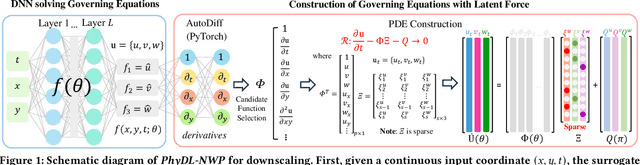

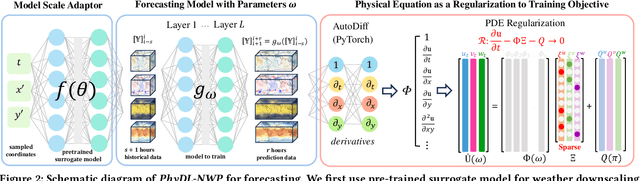
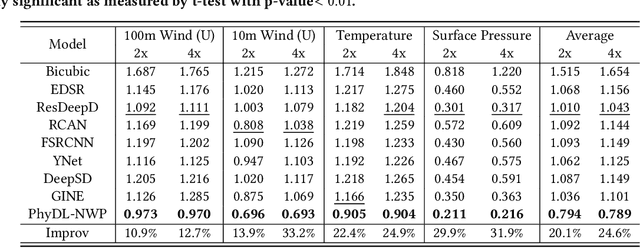
Weather forecasting is essential but remains computationally intensive and physically incomplete in traditional numerical weather prediction (NWP) methods. Deep learning (DL) models offer efficiency and accuracy but often ignore physical laws, limiting interpretability and generalization. We propose PhyDL-NWP, a physics-guided deep learning framework that integrates physical equations with latent force parameterization into data-driven models. It predicts weather variables from arbitrary spatiotemporal coordinates, computes physical terms via automatic differentiation, and uses a physics-informed loss to align predictions with governing dynamics. PhyDL-NWP enables resolution-free downscaling by modeling weather as a continuous function and fine-tunes pre-trained models with minimal overhead, achieving up to 170x faster inference with only 55K parameters. Experiments show that PhyDL-NWP improves both forecasting performance and physical consistency.
R&D-Agent: Automating Data-Driven AI Solution Building Through LLM-Powered Automated Research, Development, and Evolution
May 20, 2025Recent advances in AI and ML have transformed data science, yet increasing complexity and expertise requirements continue to hinder progress. While crowdsourcing platforms alleviate some challenges, high-level data science tasks remain labor-intensive and iterative. To overcome these limitations, we introduce R&D-Agent, a dual-agent framework for iterative exploration. The Researcher agent uses performance feedback to generate ideas, while the Developer agent refines code based on error feedback. By enabling multiple parallel exploration traces that merge and enhance one another, R&D-Agent narrows the gap between automated solutions and expert-level performance. Evaluated on MLE-Bench, R&D-Agent emerges as the top-performing machine learning engineering agent, demonstrating its potential to accelerate innovation and improve precision across diverse data science applications. We have open-sourced R&D-Agent on GitHub: https://github.com/microsoft/RD-Agent.
Generating Full-field Evolution of Physical Dynamics from Irregular Sparse Observations
May 14, 2025Modeling and reconstructing multidimensional physical dynamics from sparse and off-grid observations presents a fundamental challenge in scientific research. Recently, diffusion-based generative modeling shows promising potential for physical simulation. However, current approaches typically operate on on-grid data with preset spatiotemporal resolution, but struggle with the sparsely observed and continuous nature of real-world physical dynamics. To fill the gaps, we present SDIFT, Sequential DIffusion in Functional Tucker space, a novel framework that generates full-field evolution of physical dynamics from irregular sparse observations. SDIFT leverages the functional Tucker model as the latent space representer with proven universal approximation property, and represents observations as latent functions and Tucker core sequences. We then construct a sequential diffusion model with temporally augmented UNet in the functional Tucker space, denoising noise drawn from a Gaussian process to generate the sequence of core tensors. At the posterior sampling stage, we propose a Message-Passing Posterior Sampling mechanism, enabling conditional generation of the entire sequence guided by observations at limited time steps. We validate SDIFT on three physical systems spanning astronomical (supernova explosions, light-year scale), environmental (ocean sound speed fields, kilometer scale), and molecular (organic liquid, millimeter scale) domains, demonstrating significant improvements in both reconstruction accuracy and computational efficiency compared to state-of-the-art approaches.
Generalized Temporal Tensor Decomposition with Rank-revealing Latent-ODE
Feb 10, 2025Tensor decomposition is a fundamental tool for analyzing multi-dimensional data by learning low-rank factors to represent high-order interactions. While recent works on temporal tensor decomposition have made significant progress by incorporating continuous timestamps in latent factors, they still struggle with general tensor data with continuous indexes not only in the temporal mode but also in other modes, such as spatial coordinates in climate data. Additionally, the problem of determining the tensor rank remains largely unexplored in temporal tensor models. To address these limitations, we propose \underline{G}eneralized temporal tensor decomposition with \underline{R}ank-r\underline{E}vealing laten\underline{T}-ODE (GRET). Our approach encodes continuous spatial indexes as learnable Fourier features and employs neural ODEs in latent space to learn the temporal trajectories of factors. To automatically reveal the rank of temporal tensors, we introduce a rank-revealing Gaussian-Gamma prior over the factor trajectories. We develop an efficient variational inference scheme with an analytical evidence lower bound, enabling sampling-free optimization. Through extensive experiments on both synthetic and real-world datasets, we demonstrate that GRET not only reveals the underlying ranks of temporal tensors but also significantly outperforms existing methods in prediction performance and robustness against noise.
Diffusion-Generative Multi-Fidelity Learning for Physical Simulation
Nov 09, 2023


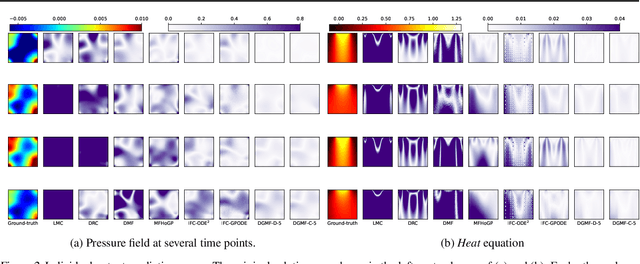
Multi-fidelity surrogate learning is important for physical simulation related applications in that it avoids running numerical solvers from scratch, which is known to be costly, and it uses multi-fidelity examples for training and greatly reduces the cost of data collection. Despite the variety of existing methods, they all build a model to map the input parameters outright to the solution output. Inspired by the recent breakthrough in generative models, we take an alternative view and consider the solution output as generated from random noises. We develop a diffusion-generative multi-fidelity (DGMF) learning method based on stochastic differential equations (SDE), where the generation is a continuous denoising process. We propose a conditional score model to control the solution generation by the input parameters and the fidelity. By conditioning on additional inputs (temporal or spacial variables), our model can efficiently learn and predict multi-dimensional solution arrays. Our method naturally unifies discrete and continuous fidelity modeling. The advantage of our method in several typical applications shows a promising new direction for multi-fidelity learning.